
Drones: how flight logs, memory cards, remote controllers and apps are acquired to reconstruct where a drone flew and who was flying it
How drones are examined forensically: flight logs in the aircraft, the remote controller and the app, photos and videos with coordinates and altitude, remote identification mandatory since 2024, operator registration on D-Flight, data in the manufacturer’s cloud, encrypted logs, procedure, tools, mistakes, value in court, a prison delivery case, checklist and frequently asked questions.

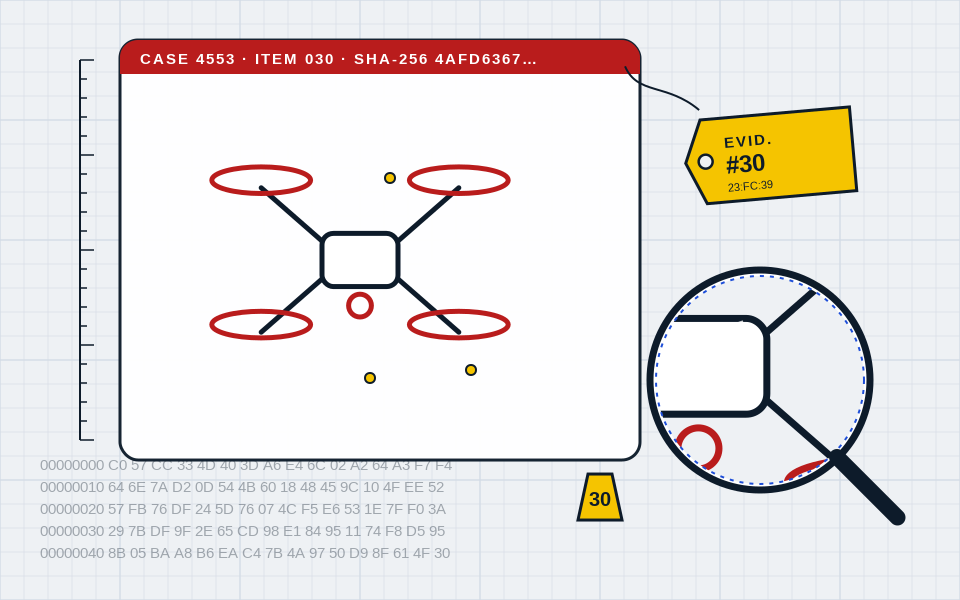
A drone is a small flying computer with GPS, a compass, a camera and storage. It records its own flight track, often in several copies: in the aircraft’s internal memory, in the remote controller, in the smartphone app that flies it and, sometimes, in the manufacturer’s cloud. The photos and videos it takes contain coordinates, altitude and camera orientation. Since 2024, in the European Union, drones with a class mark also broadcast by radio the operator’s number and the pilot’s position.
For digital forensics drones are an increasingly frequent exhibit: phones and drugs delivered into prisons, flights over airports and infrastructure, unlawful filming of homes, accidents. The difficulty is that much of the data is encrypted and that the seized drone is often damaged or found without its controller: the reconstruction comes from cross-checking several sources.
Where the data is
- Aircraft
- Flight logs in internal memory, often encrypted, and the serial number.
- Memory card
- Photos and videos with coordinates, altitude, camera orientation and date.
- Remote controller
- On models with a screen, flight logs, paired drones, maps and media.
- Smartphone app
- Flight logs, the account used, paired drones, saved maps.
- Manufacturer’s cloud
- Synced logs, account data, linked devices.
- Remote identification
- Radio signals with the operator’s number and the position of drone and pilot.
Drone photos are analysed as in EXIF and photo metadata; the app lives on the phones covered in Android smartphones and iPhone; cards are handled as in USB drives and SD cards, manufacturer data as in cloud acquisition. The basic entries are GPS coordinates, EXIF and non-repeatable examination.
The pages of this topic
Drones: how they work
How drone data works from a forensic point of view: the parts of the system, flight logs kept in several copies, photos with altitude and orientation metadata, remote identification and operator registration, encrypted logs on recent models.
Drones: the procedure
The procedure for acquiring a drone: making the aircraft and battery safe, isolating it from networks, documenting serial numbers and QR code, looking for the controller and phone, copying the memory card, extracting the logs, requesting data from D-Flight and the manufacturer, cross-checking sources.
Drones: tools
Tools for drone analysis: manufacturer software to export logs, DatCon and CsvView for aircraft files, viewers such as Airdata and PhantomHelp, forensic suites such as Magnet AXIOM, remote identification receivers, ExifTool for photo metadata, write blockers for cards.
Drones: mistakes to avoid
The most common mistakes with drones: leaving them connected, switching them on out of curiosity, looking only for the aircraft, ignoring the battery, trusting a single log, confusing local time and UTC, misreading altitude, using incompatible tools.
Drones: value in court
The rules on drone data as evidence: non-repeatable examinations of the aircraft, seizure of the whole system, D-Flight and manufacturer data, the European production order, unlawful interference with private life, privacy of footage.
Drones: a case
A guided case: a drone carrying phones falls into a prison yard; the memory card, aircraft logs, manufacturer data and cell sites lead to the take-off point and the pilot.
Drones: checklist
The checklist for acquiring a drone: safety and seizure, data acquisition, external sources and report.
Drones: frequently asked questions
Short answers to the most common questions about the forensic examination of drones.
More topics in this section
Android forensics
How an Android smartphone is acquired and analysed: states before and after first unlock, file-based encryption, network isolation, logical, file system, full and cloud extractions, artefacts of messages, apps, locations and usage, tools, mistakes, rules on seizure and data access, a road accident case, checklist and frequently asked questions.
9 pages
iPhone forensics
How an iPhone is acquired and analysed: data protection classes and the Secure Enclave, states before and after first unlock, USB Restricted Mode and inactivity reboot, encrypted local backups, iCloud and Advanced Data Protection, file system extractions, artefacts of messages, photos, locations and usage, tools, mistakes, value in court, a deleted messages case, checklist and frequently asked questions.
9 pages
Hard drives and SSDs
How hard drives and solid-state drives are examined: differences between magnetic disks and flash memory, SATA and NVMe interfaces, hidden HPA and DCO areas, SMART data, TRIM and internal clean-up, encryption with BitLocker, FileVault and self-encrypting drives, damaged disks, procedure, tools, mistakes, value in court, a case, checklist and frequently asked questions.
9 pages