
Connected cars: how infotainment, telematics and event recorder data are acquired to reconstruct what happened
How connected car data are acquired and analysed: infotainment with paired phones, contacts, calls and navigation, the telematics unit and manufacturer data, the event data recorder mandatory since 2024, eCall, cameras and recordings, insurance black boxes, procedure, tools, mistakes, value in court, a case, checklist and frequently asked questions.

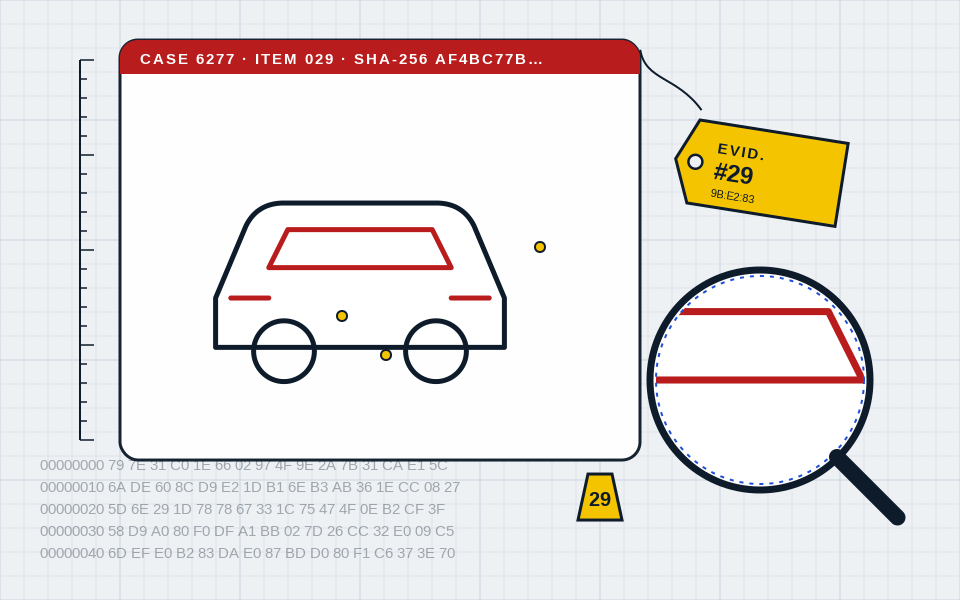
A modern car is a set of computers on wheels. The infotainment system keeps paired phones, contacts and calls, navigation destinations; the telematics unit, with its own SIM, sends position and driving data to the manufacturer; the event data recorder stores speed and braking in the seconds around a crash; driver-assistance cameras and, in some models, surveillance recordings saved on a USB stick complete the picture.
For an examiner they are valuable but difficult sources: each manufacturer and model has different modules, specialised tools are needed, and the most complete data are often on the manufacturer’s servers. They are also deeply personal data: in 2023 a Mozilla review failed every one of the 25 car brands it examined on privacy.
Where the data are
- Infotainment
- Paired phones, contacts, call logs, sometimes messages, USB and Bluetooth devices.
- Navigation
- Routes, destinations, favourites, recorded positions.
- Telematics unit
- The module with a SIM that sends position, status and driving data to the manufacturer.
- Event data recorder
- Speed, braking, seatbelts and other parameters in the seconds around a crash.
- Cameras
- Driver-assistance systems and, in some cars, recordings saved on USB memory.
- Apps and keys
- Remote locking, unlocking and starting recorded by the app and the manufacturer.
Car data are cross-checked with those of paired Android smartphones and iPhones; for recordings see USB drives and SD cards, for manufacturer data cloud acquisition. The basic entries are GPS coordinates, physical acquisition and non-repeatable examination.
The pages of this topic
Connected cars: how they work
How car data work from a forensic point of view: infotainment, the telematics unit, the event data recorder, eCall, cameras and recordings, the manufacturer’s cloud and apps, data that remain after pairing a phone.
Connected cars: the procedure
The procedure for acquiring a car’s data: secure the vehicle, limit connections, do not switch on the system without reason, identify the modules, acquire infotainment and the event recorder, recover recordings, request data from the manufacturer, cross-check sources.
Connected cars: tools
The tools for car data: Berla iVe for infotainment and navigation, event recorder readers such as Bosch CDR, OBD interfaces, memory acquisition, analysis of paired phones, manufacturers’ procedures.
Connected cars: mistakes to avoid
The most common mistakes with car data: switching on the system out of curiosity, leaving the car connected, arriving late, forgetting the cloud, trusting clocks, ignoring passengers’ data, dismantling without safeguards, using unsuitable tools.
Connected cars: value in court
The rules on car data as evidence: non-repeatable examinations on the vehicle, the value of event recorder data, insurance black boxes and art. 145-bis of the Italian Insurance Code, data held by manufacturers and the European Production Order, privacy, the Data Act.
Connected cars: a case
A guided case: after a pedestrian is struck at night, the car’s event recorder and infotainment, cross-checked with the phone records, reconstruct speed, braking and the call in progress.
Connected cars: checklist
The checklist for acquiring a car’s data: vehicle and connections, module acquisition, external data and report.
Connected cars: frequently asked questions
Short answers to the most common questions about connected car data.
More topics in this section
Android forensics
How an Android smartphone is acquired and analysed: states before and after first unlock, file-based encryption, network isolation, logical, file system, full and cloud extractions, artefacts of messages, apps, locations and usage, tools, mistakes, rules on seizure and data access, a road accident case, checklist and frequently asked questions.
9 pages
iPhone forensics
How an iPhone is acquired and analysed: data protection classes and the Secure Enclave, states before and after first unlock, USB Restricted Mode and inactivity reboot, encrypted local backups, iCloud and Advanced Data Protection, file system extractions, artefacts of messages, photos, locations and usage, tools, mistakes, value in court, a deleted messages case, checklist and frequently asked questions.
9 pages
Hard drives and SSDs
How hard drives and solid-state drives are examined: differences between magnetic disks and flash memory, SATA and NVMe interfaces, hidden HPA and DCO areas, SMART data, TRIM and internal clean-up, encryption with BitLocker, FileVault and self-encrypting drives, damaged disks, procedure, tools, mistakes, value in court, a case, checklist and frequently asked questions.
9 pages