
Chain of custody: the documented history of every piece of digital evidence
What the chain of custody is, why without it even perfect evidence can become unreliable and how to keep it properly for devices and digital copies.

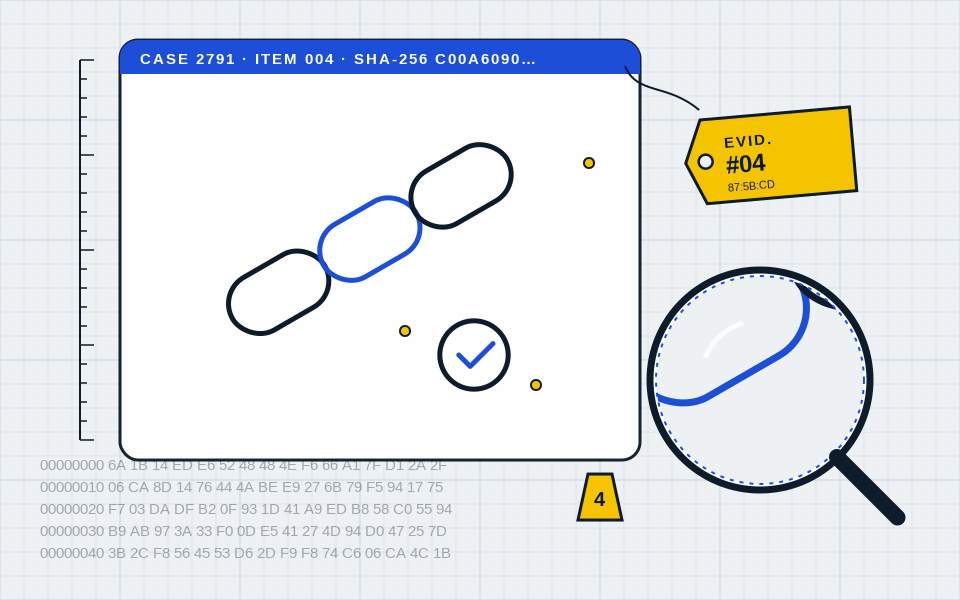
The chain of custody is the record that tells the life of a piece of evidence from the moment it is collected until it is presented in court, returned or destroyed. For each step it states who held it, when, where, why and in what condition.
It may look like bureaucracy, but it is the heart of evidential reliability. A technically flawless analysis loses much of its value if nobody can say where a phone stayed for three days or who had access to the copy of a disk. The question the chain of custody must always be able to answer is simple: how do we know this is really the evidence that was collected, and that nobody has changed it?
A double chain: object and data
In the digital world the chain of custody runs on two parallel tracks. On one side there is the physical object — the phone, the disk, the USB stick — which is sealed, labelled and stored. On the other there are the digital copies: forensic images, extracted files, cloud exports. These too have their own history, made of the media they are kept on, the people who access them and the hash values that attest their integrity.
- Identity
- Each item has a unique identifier that follows it through every document.
- Integrity
- Seals for objects, hash values for data: they must be intact at every check.
- Continuity
- No period of time without an identified person responsible.
- Traceability
- Every access, copy or analysis leaves a written trace.
The following pages explain how a chain of custody is built, which tools are needed, the mistakes that break it and the weight it carries before a judge. For the duplication technique see Forensic image; for mathematical seals, Hashes and integrity.
The pages of this topic

Chain of custody: how it works
Identifiers, seals, hash values and logs: the mechanisms that make digital evidence traceable.

Chain of custody: the step-by-step procedure
From collection to return: how every step of a digital exhibit and its copies is documented.

Chain of custody: the tools
Forms, tamper-evident bags, labels, evidence-management software, hashes and timestamps.
Chain of custody: the mistakes that break it
Time gaps, missing signatures, copies on personal computers: the mistakes that make evidence open to challenge.
Chain of custody: value in court
What the Italian code of criminal procedure and technical standards require, and what happens in court when the chain has gaps.

Chain of custody: a case study
A law firm hands a laboratory a USB stick with evidence for a lawsuit: how every step is documented.

Chain of custody: the checklist
The checks to make at every handover of a digital exhibit and its copies.

Chain of custody: frequently asked questions
Short answers to the most common doubts about the chain of custody of digital evidence.
More topics in this section
Digital forensics
Digital forensics explained clearly: what it does, its principles, the stages of a digital investigation, the tools and the value of digital evidence in court.
9 pages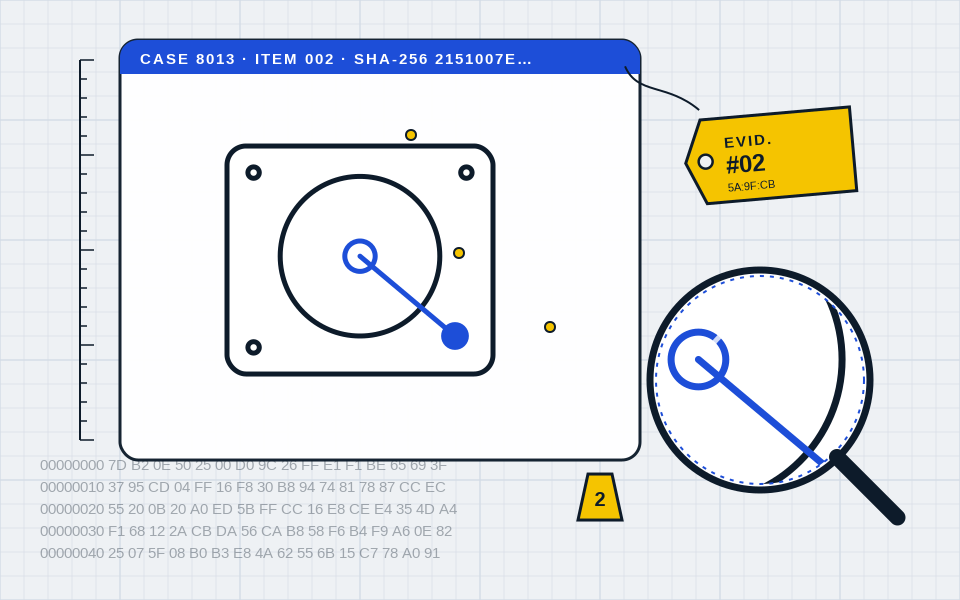
Forensic image
What a forensic (bit-stream) image is, why it differs from an ordinary copy of files and how to prove it is identical to the original.
9 pages
Hashes and integrity
What a hash value is, why a single different bit changes it and how it is used to prove that digital evidence has not been altered.
9 pages