
The write blocker: reading a disk without being able to change it
What a write blocker is, why it is essential for acquiring a disk without altering it, the differences between hardware and software models, how to use it and how to verify it.

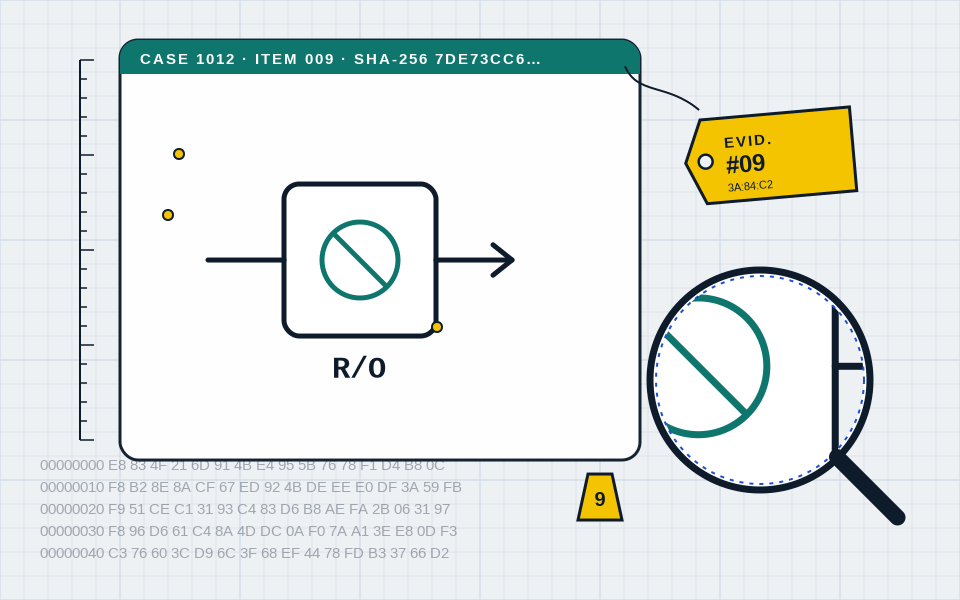
Connecting a disk to a computer seems harmless: you plug it in, open the folders, copy what you need. In reality, as soon as an operating system recognises a disk it starts writing to it: it updates access dates, creates hidden indexing files, mounts and repairs the file system, sometimes launches programs. For everyday use it does not matter. For evidence, it does.
The write blocker is the tool that prevents this. It sits between the medium being acquired and the examiner’s computer and lets through only read commands, blocking any write command. It is the first material, verifiable guarantee that the forensic image is made without touching the original.
Why the operating system “dirties” disks
- Access dates
- Opening a folder or file can update the last-access dates recorded by the file system.
- Indexing
- Systems create hidden files and folders for search, thumbnails and the recycle bin.
- Repair
- If the file system appears damaged, the system may try to repair it, changing structures that hold traces.
- Mounting
- Simply mounting some file systems updates internal counters and logs.
A write blocker removes these risks at the root. Together with hash values, it makes it possible to show that the original has not changed.
The pages of this topic
Write blocker: how it works
How a write blocker filters commands between computer and disk, the difference between hardware and software blocking, and the different interface types.
Write blocker: the step-by-step procedure
How a write blocker is used during a forensic acquisition, from the preliminary check to documentation in the record.
Write blocker: the tools
The types of write blocker available — desktop, portable, for USB and memory cards, software — and how to choose the right kit.
Write blocker: pitfalls to avoid
Connecting the disk without a blocker “just for a moment”, not verifying the device, confusing original and destination: the most common mistakes.
Write blocker: value in court
Why using a write blocker is the practical proof of the safeguards required by Italian Law 48/2008 and how it should be documented.
Write blocker: a case study
An external hard disk handed over in a business dispute: how the write blocker check and the record closed the challenge.
Write blocker: the checklist
The essential checks before, during and after using a write blocker in a forensic acquisition.
Write blocker: frequently asked questions
Short answers to the most common doubts about using write blockers in forensic acquisitions.
More topics in this section
Web page acquisition
How to document a web page, post or website so that it counts as evidence: the limits of screenshots, forensic acquisition, value in Italian courts and mistakes to avoid.
9 pages
Forensic acquisition of email
How emails are acquired as evidence: original format, complete headers, DKIM signatures, cloud mailboxes, Italian certified email (PEC), pitfalls to avoid and the value in court of ordinary and certified email.
9 pages