
SIM cards and call records: what can be learned from a SIM card, from telephone traffic records and from cells, how they are acquired and what they are worth at trial
Digital forensics of SIM cards and call records: the ICCID, IMSI, IMEI and phone number identifiers, data on SIMs and eSIMs, what telephone and internet traffic records contain, cells and approximate location, retention and acquisition under art. 132 of the Italian Privacy Code, the Court of Justice ruling in the Bolzano case, procedure, tools, mistakes, value in court, a SIM swap case, checklist and frequently asked questions.

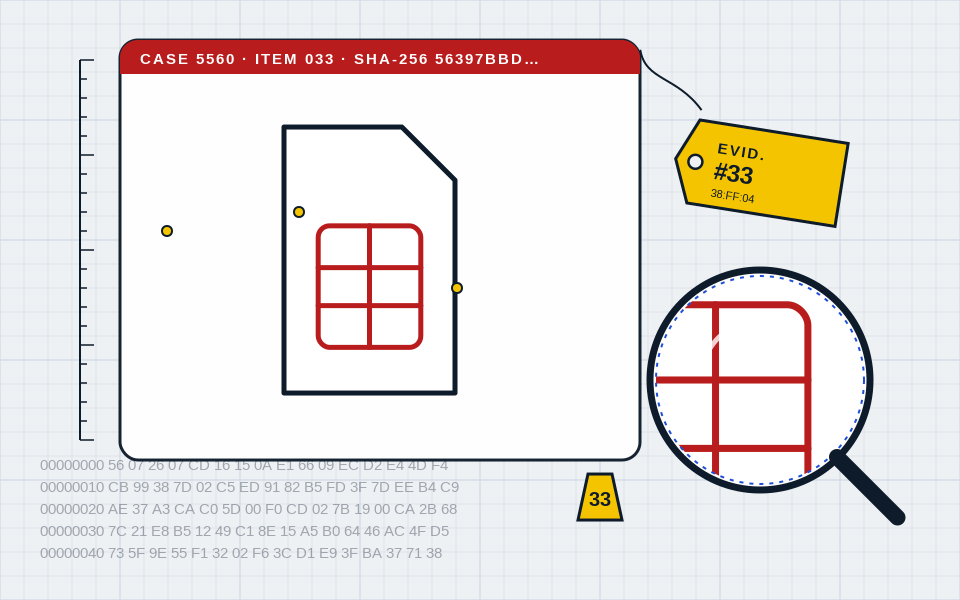
The SIM is the card that identifies the subscriber on the mobile network; call records (in Italy, tabulati) are the logs the operator keeps for every call, text message and data connection: who, when, for how long, through which cell. They contain neither the words spoken nor the texts written, but they make it possible to reconstruct contacts, sequences and movements, and they are among the most used evidence in criminal trials.
Precisely because they tell so much, they must be read with precision. A call record describes a SIM and a phone, not the person using them; a cell indicates an area, not a point; and since the 2021 reform acquisition in Italy follows strict rules, whose breach makes the data unusable.
The identifiers
- ICCID
- The SIM’s serial number, printed on the card.
- IMSI
- Identifies the subscriber on the mobile network and is recorded by the operator.
- Phone number
- The number associated with the SIM, which can move to another card.
- IMEI
- Identifies the phone, not the SIM: it changes if the card moves to another handset.
- eSIM
- An operator profile downloaded into a chip soldered into the phone, with no physical card.
- Cell
- The antenna and sector that served the communication.
SIM cards and call records are read together with Android smartphones and iPhones, IP addresses and the rules on dates and time zones. The basic entries are IMSI, IMEI, call records and cell site.
The pages of this topic
SIM cards and call records: how the evidence works
How evidence from SIM cards and call records works: what a physical SIM, an eSIM, telephone and internet traffic records, cell data and messaging apps contain, and why a cell indicates an area and not a point.
SIM cards and call records: step-by-step procedure
The procedure for evidence from SIM cards and call records: documenting SIM and phone, isolating, acquiring the SIM and the device, requesting call records, cell data and activation data, normalising, analysing, verifying in the field.
SIM cards and call records: tools
Tools for SIM cards and call records: forensic SIM readers, extraction software, call record analysis, GIS maps, coverage measurements, IMEI code databases, documentation.
SIM cards and call records: mistakes to avoid
The most common mistakes with SIM cards and call records: confusing SIM and person, reading a cell as a point, ignoring time zones, forgetting apps, arriving late, guessing PINs, overlooking IMEI changes and activation data.
SIM cards and call records: value in court
The value of SIM cards and call records in court: acquisition by a judge’s decree under art. 132 of the Italian Privacy Code, urgency, unusability, seriousness of the offence after ruling C-178/22, evidential value and reading cells.
SIM cards and call records: a guided case
A guided case: a SIM swap followed by fraudulent bank transfers, reconstructed with the operator’s logs, the new SIM’s call record, the IMEI, the bank’s text messages, the cells and the shop’s CCTV.
SIM cards and call records: checklist
The checklist for SIM cards and call records: on site, requests to the operator, analysis and report.
SIM cards and call records: frequently asked questions
Short answers to the most common questions about SIM cards, call records and cells.
More topics in this section
Android forensics
How an Android smartphone is acquired and analysed: states before and after first unlock, file-based encryption, network isolation, logical, file system, full and cloud extractions, artefacts of messages, apps, locations and usage, tools, mistakes, rules on seizure and data access, a road accident case, checklist and frequently asked questions.
9 pages
iPhone forensics
How an iPhone is acquired and analysed: data protection classes and the Secure Enclave, states before and after first unlock, USB Restricted Mode and inactivity reboot, encrypted local backups, iCloud and Advanced Data Protection, file system extractions, artefacts of messages, photos, locations and usage, tools, mistakes, value in court, a deleted messages case, checklist and frequently asked questions.
9 pages
Hard drives and SSDs
How hard drives and solid-state drives are examined: differences between magnetic disks and flash memory, SATA and NVMe interfaces, hidden HPA and DCO areas, SMART data, TRIM and internal clean-up, encryption with BitLocker, FileVault and self-encrypting drives, damaged disks, procedure, tools, mistakes, value in court, a case, checklist and frequently asked questions.
9 pages