
Forensic timeline: reconstructing over time what happened on a computer or smartphone
How a forensic timeline is built: file dates, system logs, browser history, Prefetch, the Windows registry, smartphones and cloud combined into a single sequence; time zones, wrong clocks, tampered dates, tools such as Plaso and Timesketch, mistakes and value in court.

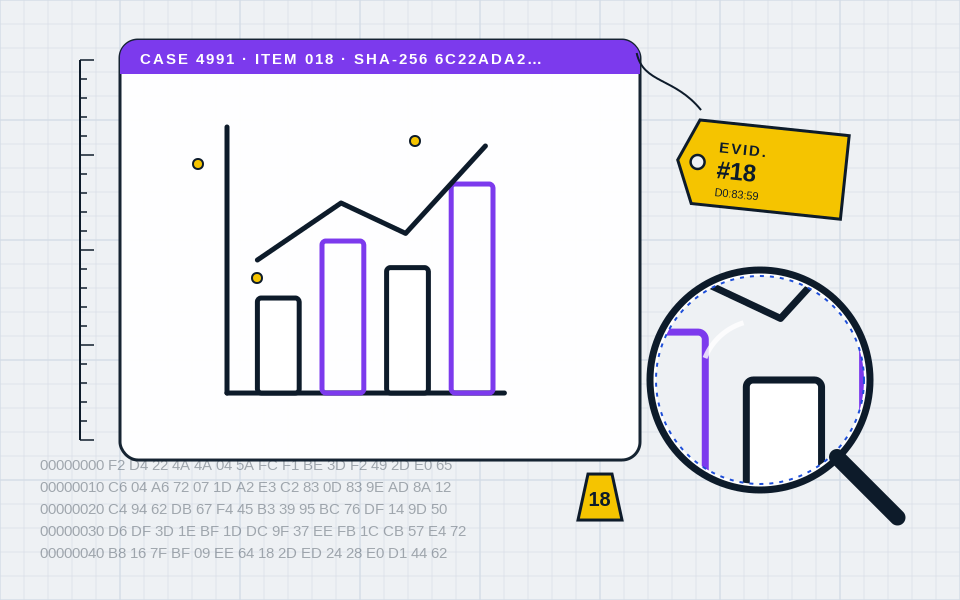
In many cases the decisive question is not “what is on the computer” but in what order things happened: when that file was opened, who was logged in when the transfer was made, whether the document existed before or after the dismissal letter. The forensic timeline answers these questions by combining into a single sequence the time traces left by systems, programs and services.
Every computer records thousands of dates: when a file was created, modified or opened, when a program was run, when a user logged in, when a USB stick was plugged in. Taken one by one they say little; lined up and compared across independent sources, they can tell a day minute by minute. Provided you do not forget that every date has its own time zone, precision and reliability.
The sources of a timeline
- File system
- Creation, modification, access and metadata change of every file, including deleted ones.
- Event logs
- Logons, session locks and unlocks, startups and shutdowns, installations, errors.
- Program execution
- Prefetch, the Windows registry and other artefacts show when a program was started.
- Browsing
- History, downloads, cookies and browser cache.
- Connected devices
- USB sticks, external drives and phones plugged in, with their dates.
- Smartphones and cloud
- Messages, photos, locations, notifications, logins to online services.
The timeline is built on a forensic copy and requires mastering dates and time zones; for file dates see also the entry MAC times.
The pages of this topic
Forensic timeline: how it works
How the digital dates used in timelines work: MACB times, NTFS attributes, Windows, Unix, Chrome and Apple date formats, FAT file systems, photos, super timelines and targeted timelines.
Forensic timeline: step-by-step procedure
The stages for building a reliable forensic timeline: questions, acquisition, time zone, extraction, normalisation, filtering, correlation, checking anomalies and presentation.
Forensic timeline: tools
The tools for forensic timelines: Plaso and Timesketch, The Sleuth Kit and Autopsy, Eric Zimmerman’s tools, commercial suites and spreadsheets for targeted timelines.
Forensic timeline: mistakes to avoid
The most common mistakes in forensic timelines: confused time zones, unverified clocks, misread access and creation dates, too much data, ignored tampering, inferences presented as facts.
Forensic timeline: value in court
The value of a timeline as evidence: source and precision of every event, stated time zones, degrees of certainty, independent confirmations, repeatability and the problem of who was really at the keyboard.
Forensic timeline: case study
A €48,000 transfer made from the accounts computer while the bookkeeper was in a meeting: how the timeline shows a remote-control session and what it cannot say.
Forensic timeline: checklist
The checks for a correct and defensible forensic timeline.
Forensic timeline: frequently asked questions
Short answers to the most common questions about forensic timelines.
More topics in this section
Forensic recovery of deleted files
What really happens when a file is deleted, when it can be recovered and when not: recycle bin, unallocated space, file system tables, carving, thumbnails, shadow copies, app databases, SSDs and encrypted smartphones, tools, mistakes and value in court.
9 pages
EXIF and photo metadata
What a digital photo’s metadata reveal: date and time, time zone, GPS coordinates, make and model, serial number, software, thumbnail; where they are kept and where they are lost, how to extract them with ExifTool, how to spot inconsistencies and edits, mistakes to avoid and value in court.
9 pages
The Windows registry in forensic analysis
How the Windows registry is analysed in a forensic investigation: the SAM, SYSTEM, SOFTWARE, NTUSER.DAT, UsrClass.dat and Amcache files, the keys on accounts, USB devices, programs run, files opened, Wi-Fi networks and autostart, last write times, transaction logs, tools, mistakes and value in court.
9 pages